Benefits of Moringa: The Complete Evidence-Based European Guide
The Complete European Guide to the World’s Most Versatile Tree
1. Moringa Introduction
Few plants have generated as much international attention in recent decades as Moringa oleifera.
Known variously as the miracle tree, drumstick tree, ben oil tree and horseradish tree, moringa has become one of the most discussed plants in modern nutrition, sustainable agriculture and climate-resilient food production.
Its popularity has expanded far beyond its traditional growing regions.
Today, moringa products are sold throughout:
-
Europe
-
North America
-
Asia
-
Africa
-
Australia
-
The Middle East
Consumers encounter moringa in:
-
Powders
-
Teas
-
Capsules
-
Nutritional blends
-
Cosmetic products
-
Seed oils
The rapid growth in awareness has led many people to ask an important question:
Why has Moringa become so popular?
The answer is surprisingly simple.
Very few plants combine so many useful characteristics within a single species.
Moringa is:
-
Fast growing
-
Drought tolerant
-
Highly versatile
-
Nutrient rich
-
Commercially valuable
-
Agriculturally adaptable
The leaves are edible.
The flowers are edible.
The immature seed pods are edible.
The seeds can be planted or pressed for oil.
The biomass generated by the tree can contribute to agricultural systems.
This versatility helps explain why moringa has remained relevant for centuries and why interest continues growing today.
However, popularity has also created confusion.
Some sources portray moringa as a miracle cure capable of solving almost every health problem.
Others dismiss it as simply another leafy vegetable.
Neither position accurately reflects reality.
Moringa is not remarkable because it performs miracles.
It is remarkable because it combines nutrition, productivity and adaptability in ways that make it genuinely useful.
For European readers, and particularly those interested in Cyprus, moringa represents an especially interesting crop.
Growing interest in:
-
Plant-based nutrition
-
Sustainable agriculture
-
Local food production
-
Climate adaptation
-
Functional foods
has created conditions that favour crops possessing the characteristics moringa offers.
The purpose of this guide is to examine fifty evidence-based benefits of moringa while separating:
-
Traditional uses
-
Scientific evidence
-
Agricultural applications
-
Commercial opportunities
2. What Is Moringa?
Moringa belongs to the botanical family Moringaceae.
Although the genus contains multiple species, Moringa oleifera is by far the most widely cultivated and commercially important.
The species is believed to have originated in northern India, particularly in regions near the foothills of the Himalayas.
From these origins, moringa gradually spread across Asia, Africa and eventually many tropical and subtropical regions throughout the world.
Over generations, communities discovered that nearly every part of the tree possessed practical value.
Leaves became important food sources.
Flowers were incorporated into traditional dishes.
Pods became staple vegetables in several cuisines.
Seeds provided oil and planting stock.
This broad utility contributed significantly to the species’ expansion.
Today, moringa is cultivated across multiple continents and is increasingly attracting attention within Southern Europe.
3. Why Moringa Has Become Globally Important
The rise of moringa reflects several broader trends occurring throughout modern agriculture and nutrition.
Plant-Based Nutrition
Consumers increasingly seek plant-derived sources of nutrition.
Moringa’s combination of protein, vitamins, minerals and naturally occurring plant compounds aligns closely with this trend.
Sustainable Agriculture
Agricultural systems face growing pressure to produce more food while using fewer resources.
Moringa’s resilience and productivity make it attractive within discussions surrounding sustainable farming.
Climate Adaptation
Many regions are experiencing increasing temperatures and greater pressure on water resources.
Crops capable of tolerating challenging conditions are becoming increasingly important.
Moringa’s drought tolerance has therefore attracted considerable interest.
Functional Foods
The functional food industry continues expanding rapidly.
Consumers increasingly seek foods that provide nutritional value while fitting easily into modern lifestyles.
Moringa powder, tea and nutritional products fit naturally within this category.
Local Food Production
Interest in local and regional food systems continues growing throughout Europe.
Where climate conditions permit cultivation, moringa may contribute to greater food resilience and diversification.
4. Nutritional
Why Moringa Has Earned Global Attention
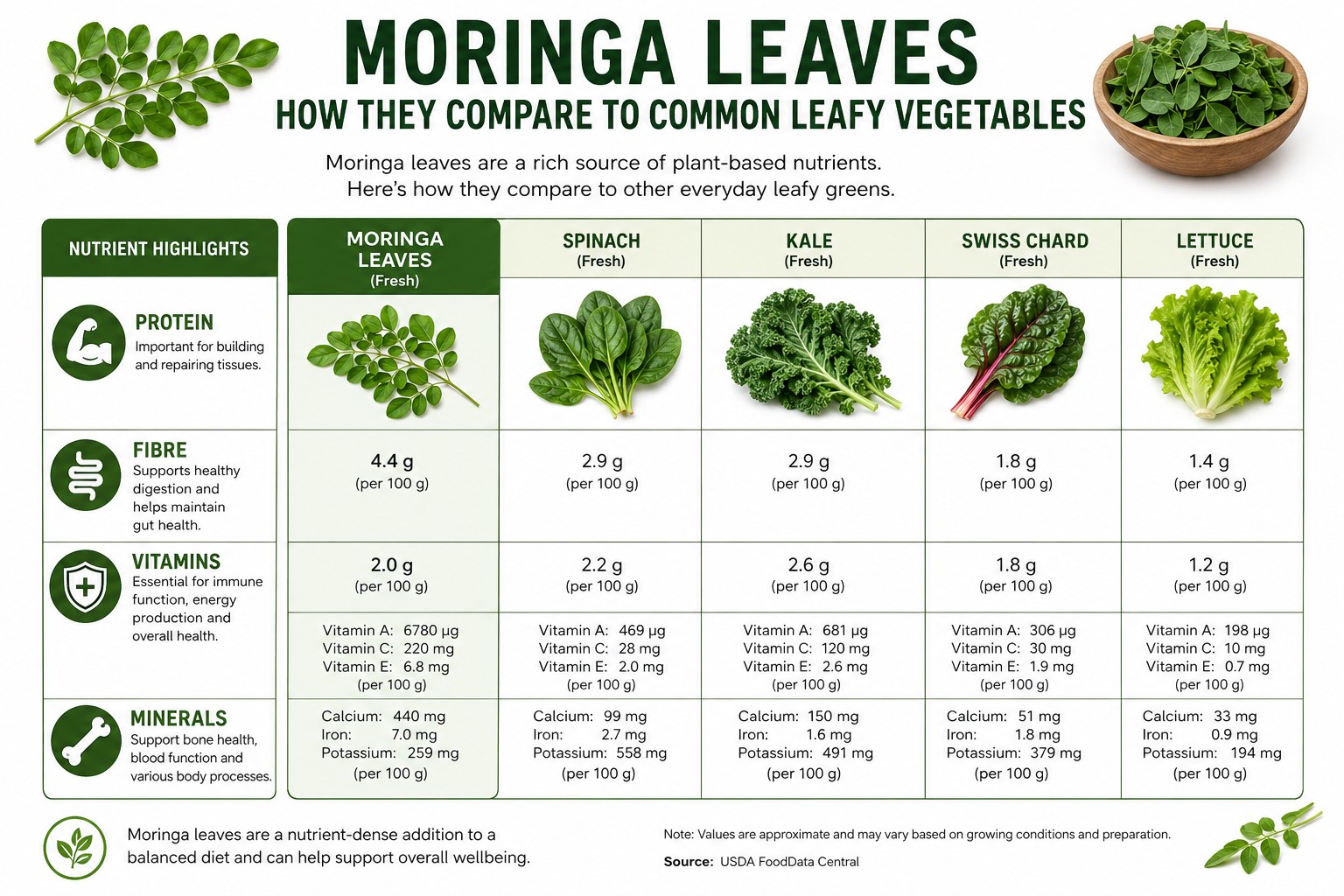
One of the primary reasons Moringa oleifera has attracted worldwide attention is its nutritional composition.
Researchers have spent decades analysing the plant’s nutrient profile.
Their findings reveal that moringa contains a broad range of nutrients within a relatively compact food source.
The significance of moringa does not depend upon any single nutrient.
Instead, it lies in the combination of nutrients present within the leaves.
Moringa provides:
-
Protein
-
Fibre
-
Vitamins
-
Minerals
-
Naturally occurring plant compounds
This combination helps explain why moringa has become popular among nutritionists, researchers and consumers alike.
Understanding Nutrient Density
Modern nutrition increasingly focuses on nutrient density rather than calories alone.
Nutrient-dense foods provide substantial nutritional value relative to their energy content.
Moringa consistently performs well within this framework.
This does not mean it should replace other foods.
Rather, it means moringa can contribute meaningful nutritional value within a balanced dietary pattern.
Many modern diets provide sufficient calories while lacking nutritional diversity.
Foods such as moringa can help address this imbalance.
The Protein Profile of Moringa
Protein remains one of the most frequently discussed aspects of moringa nutrition.
Proteins contribute to:
-
Muscle maintenance
-
Tissue repair
-
Hormone production
-
Enzyme production
-
Immune system function
Compared with many leafy vegetables, moringa contains relatively high levels of protein.
This characteristic has attracted attention from:
-
Vegetarians
-
Vegans
-
Athletes
-
Older adults
-
Nutrition researchers
The significance of this protein content becomes even more interesting when amino acid composition is considered.
Essential Amino Acids
Proteins are composed of amino acids.
Several amino acids are classified as essential because they must be obtained through food.
Moringa contains all essential amino acids.
This characteristic contributes significantly to its reputation as a nutritionally valuable plant.
However, moringa should be viewed as a contributor to dietary diversity rather than a replacement for all other protein sources.
The most effective nutritional strategies rely upon variety rather than dependence on any single food.
Vitamins Found in Moringa
Moringa contains a variety of vitamins including:
-
Vitamin A precursors
-
Vitamin C
-
Vitamin E
-
Several B vitamins
These nutrients contribute to numerous biological processes.
The presence of multiple vitamins within a single edible plant helps explain why moringa has attracted scientific interest around the world.
Minerals Found in Moringa
Minerals present within moringa include:
-
Calcium
-
Potassium
-
Magnesium
-
Iron
-
Zinc
-
Phosphorus
These minerals contribute to:
-
Bone health
-
Muscle function
-
Nerve transmission
-
Oxygen transport
-
Enzyme activity
Together they strengthen moringa’s reputation as a nutrient-rich food source.
Fibre and Plant Compounds
Moringa contributes useful dietary fibre while simultaneously providing numerous naturally occurring plant compounds.
Researchers have identified compounds including:
-
Quercetin
-
Kaempferol
-
Chlorogenic acid
-
Polyphenols
-
Flavonoids
These compounds continue attracting scientific interest because of their biological activity.
Fresh Leaves Versus Powder
Fresh leaves and powder both offer advantages.
Fresh leaves provide:
-
Minimal processing
-
Culinary flexibility
-
Garden-to-table freshness
Powder provides:
-
Convenience
-
Long shelf life
-
Easy transportation
-
Consistent availability
The most appropriate format depends upon individual circumstances and preferences.
5. Nutritional Deep Dive Conclusion
The nutritional significance of moringa does not depend upon extraordinary claims.
Its value lies in the broad combination of nutrients it provides.
Protein.
Essential amino acids.
Vitamins.
Minerals.
Fibre.
Naturally occurring plant compounds.
Very few leafy plants combine all of these characteristics within a single edible crop.
When viewed as part of a varied and balanced diet, moringa represents one of the most nutritionally interesting plants currently attracting global attention.
This nutritional foundation helps explain why the species continues gaining popularity among consumers, researchers and entrepreneurs around the world.
However, nutrition is only one part of the story.
To fully understand moringa’s importance, it is necessary to explore the practical benefits that have helped the plant remain relevant for centuries.
9. Benefits 1–20
Nutrition and Wellness Benefits
The following twenty benefits represent the nutritional and wellness foundations upon which moringa’s reputation has been built.
Benefit 1: Exceptional Nutrient Density
One of moringa’s greatest strengths is nutrient density.
Nutrient-dense foods provide substantial nutritional value relative to their calorie content.
Moringa contains:
-
Protein
-
Vitamins
-
Minerals
-
Fibre
-
Plant compounds
within a relatively low-calorie food source.
This combination contributes significantly to its reputation.
Benefit 2: Valuable Plant Protein
Protein performs numerous essential functions within the body.
Compared with many leafy vegetables, moringa contains relatively high protein levels.
This characteristic has made it attractive to:
-
Vegetarians
-
Vegans
-
Athletes
-
Health-conscious consumers
Benefit 3: Contains Essential Amino Acids
Moringa contains all essential amino acids.
This is relatively uncommon among leafy vegetables and contributes to the plant’s nutritional value.
Benefit 4: Rich in Vitamins
The leaves contain multiple vitamins including:
-
Vitamin A precursors
-
Vitamin C
-
Vitamin E
-
B vitamins
These nutrients contribute to a variety of biological processes.
Benefit 5: Rich in Minerals
Moringa contains several important minerals including:
-
Calcium
-
Potassium
-
Magnesium
-
Iron
-
Zinc
-
Phosphorus
Together these minerals strengthen its nutritional profile.
Benefit 6: Source of Dietary Fibre
Dietary fibre contributes to:
-
Digestive health
-
Normal bowel function
-
Overall dietary quality
Moringa provides useful amounts while simultaneously supplying additional nutrients.
Benefit 7: Naturally Low in Calories
Despite its nutritional richness, moringa remains relatively modest in calories.
This allows consumers to increase nutrient intake without dramatically increasing energy intake.
Benefit 8: Rich in Antioxidant Compounds
Researchers have identified numerous antioxidant compounds including:
-
Quercetin
-
Kaempferol
-
Chlorogenic acid
-
Polyphenols
These compounds continue attracting scientific interest.
Benefit 9: Supports Dietary Diversity
Nutrition experts increasingly encourage dietary variety.
Moringa introduces an additional nutrient-rich food source into the diet.
Benefit 10: Suitable for Plant-Based Diets
Moringa integrates easily into:
-
Vegetarian diets
-
Vegan diets
-
Flexitarian diets
Its nutrient profile aligns naturally with these eating patterns.
11. WellnessMoringa Benefits of Moringa
Beyond basic nutrition, Moringa has become associated with broader wellness discussions.
It is important to distinguish between nutritional support and medical claims.
The following benefits relate primarily to nutritional contribution and scientific interest.
Benefit 12: Supports Overall Nutritional Quality
Moringa contributes multiple nutrients simultaneously.
Its value lies in the breadth of nutrients it provides rather than dependence upon any single nutrient.
Benefit 13: Provides Natural Antioxidants
Consumers increasingly seek foods that naturally contain antioxidant compounds.
Moringa contributes to this objective as part of a diverse diet.
Benefit 14: Contains Bioactive Plant Compounds
Researchers continue investigating various phytochemicals present within moringa.
These compounds contribute significantly to ongoing scientific interest.
Benefit 15: May Support Healthy Glucose Metabolism
Several studies have explored potential relationships between moringa and glucose metabolism.
Research remains ongoing and conclusions should be interpreted responsibly.
Benefit 16: May Support Healthy Cholesterol Markers
Researchers have investigated possible effects on cholesterol-related markers.
While findings remain interesting, further research is required.
Benefit 17: Contains Naturally Occurring Anti-Inflammatory Compounds
Laboratory studies have identified compounds demonstrating anti-inflammatory activity.
These findings continue attracting scientific attention.
Benefit 18: Supports Healthy Aging Through Nutrition
Nutrient-rich foods contribute to overall nutritional adequacy, an important component of healthy aging.
Moringa may contribute positively within this context.
Benefit 19: Supports Immune Function Through Nutrition
Several nutrients found in moringa contribute to normal immune system function.
Examples include:
-
Vitamin A precursors
-
Vitamin C
-
Zinc
-
Iron
Benefit 20: Supports Skin Health
Moringa has attracted interest because of both its nutritional profile and the characteristics of its seed oil.
Moringa oil appears in numerous skincare products.
Benefit 21: Supports Hair Care Applications
Moringa seed oil is increasingly used within:
-
Hair serums
-
Shampoos
-
Conditioners
-
Hair treatments
Its commercial popularity continues growing.
22. Culinary Uses of Moringa
One of the most remarkable characteristics of moringa is the number of edible products that can be obtained from a single tree.
Few plants offer such diversity.
Benefit 23: Fresh Leaves Can Be Consumed Directly
Fresh leaves may be incorporated into:
-
Salads
-
Soups
-
Sandwiches
-
Omelettes
-
Vegetable dishes
This simplicity contributes to their popularity.
Benefit 24: Leaves Can Be Cooked Like Traditional Greens
Moringa leaves can be prepared similarly to:
-
Spinach
-
Kale
-
Chard
This flexibility makes adoption easier for new consumers.
Benefit 25: Immature Pods Are Highly Valued Food Crops
Known as drumsticks, immature pods are important ingredients in many traditional cuisines.
They are especially popular throughout South Asia.
Benefit 26: Flowers Are Edible
Moringa flowers are consumed in several regions and provide another harvestable food product.
Benefit 27: Seeds Have Multiple Uses
Seeds may be:
-
Planted
-
Pressed for oil
-
Used within educational growing projects
Their versatility contributes to the plant’s value.
Benefit 28: Powder Provides Exceptional Convenience
Powder allows consumers to use moringa in:
-
Smoothies
-
Shakes
-
Soups
-
Yoghurt
-
Oatmeal
This convenience has contributed significantly to global popularity.
Benefit 29: Long Shelf Life
Properly processed moringa powder stores significantly longer than fresh leaves.
This improves commercial viability.
Benefit 30: Useful in Food Fortification
Moringa has been explored as an ingredient within:
-
Bread
-
Crackers
-
Nutritional bars
-
Functional beverages
because of its nutrient profile.
Benefit 31: Compatible With Modern Food Trends
Consumer interest in:
-
Natural foods
-
Plant-based foods
-
Functional foods
continues increasing.
Moringa aligns closely with these trends.
Benefit 32: Extraordinary Culinary Versatility
The ability to utilise:
-
Leaves
-
Flowers
-
Pods
-
Seeds
within a single species remains one of moringa’s most impressive characteristics.
Agricultural Advantages of Moringa
The next ten benefits explain why moringa continues attracting interest from farmers, researchers and sustainability advocates.
Benefit 33: Rapid Growth Rate
Moringa is capable of establishing and growing quickly under favourable conditions.
This contributes to:
-
Earlier productivity
-
Faster harvest opportunities
-
Improved economic potential
Benefit 34: Excellent Drought Tolerance
Once established, moringa demonstrates notable drought resilience.
This characteristic is especially important in regions experiencing water pressure.
Benefit 35: Heat Tolerance
The species performs well under warm conditions and remains relevant within discussions surrounding climate adaptation.
Benefit 36: Produces Significant Biomass
Moringa generates substantial amounts of:
-
Leaves
-
Branches
-
Pruning material
which may contribute to broader agricultural systems.
Benefit 37: Suitable for Agroforestry Systems
Moringa integrates effectively into diversified farming systems and agroforestry projects.
Benefit 38: Supports Local Food Production
Interest in local food systems continues growing throughout Europe.
Consumers increasingly value:
-
Traceability
-
Freshness
-
Reduced transportation distances
Moringa offers opportunities for local cultivation in suitable climates.
This can contribute to stronger regional food systems and greater agricultural diversity.
Benefit 39: Suitable for Small Farms and Homesteads
Unlike some crops that favour large industrial operations, moringa can be cultivated successfully at smaller scales.
Potential users include:
-
Homesteaders
-
Lifestyle farmers
-
Community gardens
-
Family farms
-
Educational projects
This accessibility broadens the plant’s appeal.
Benefit 40: Supports Pollinators
Moringa flowers attract:
-
Bees
-
Butterflies
-
Beneficial insects
Pollinators perform critical roles within agricultural ecosystems.
Supporting pollinator populations contributes value far beyond the tree itself.
Benefit 41: Relevant to Climate Adaptation
Climate adaptation has become one of the defining agricultural challenges of the twenty-first century.
Moringa combines:
-
Drought tolerance
-
Heat tolerance
-
Rapid growth
-
Productivity
These characteristics make it increasingly relevant to discussions about future farming systems.
Benefit 42: Easy to Incorporate Into Daily Life
Moringa is available in multiple forms including:
-
Fresh leaves
-
Powder
-
Tea
-
Capsules
-
Seed oil
This flexibility makes it easy for consumers to integrate into their routines.
Benefit 43: Available in Multiple Commercial Formats
Commercial products include:
-
Powders
-
Teas
-
Capsules
-
Oils
-
Fresh produce
-
Dried leaves
-
Seedlings
Few crops generate such a wide range of product opportunities.
Benefit 44: Long-Term Storage Potential
Properly processed moringa products can be stored for extended periods.
This supports:
-
Inventory management
-
Export opportunities
-
Reduced waste
and improves overall commercial viability.
Benefit 45: Supports Balanced Dietary Patterns
Moringa should not replace a varied diet.
Its value lies in complementing existing dietary habits and contributing additional nutrients.
Benefit 46: Encourages Food Diversity
Modern diets often rely heavily upon a limited number of crops.
Moringa introduces another nutritious option, increasing diversity within food systems.
Benefit 47: Suitable for Diverse Consumer Groups
Interest in moringa spans:
-
Vegetarians
-
Vegans
-
Athletes
-
Gardeners
-
Sustainability advocates
-
Farmers
-
Entrepreneurs
Few crops attract such a broad audience.
Benefit 48: Supports Functional Food Innovation
The global functional food industry continues expanding.
Moringa is increasingly explored within:
-
Nutritional beverages
-
Wellness products
-
Protein blends
-
Fortified foods
This trend appears likely to continue.
Benefit 49: Creates Small Business Opportunities
Moringa supports a variety of business models including:
-
Nurseries
-
Tree sales
-
Powder production
-
Tea production
-
Workshops
-
Educational projects
This flexibility increases commercial appeal.
Benefit 50: Supports Sustainable Business Models
A single planting may generate multiple revenue streams:
-
Leaves
-
Powder
-
Tea
-
Seeds
-
Seedlings
-
Oil
Diversification improves resilience and reduces dependence upon a single product category.
Benefit 51: One of the Most Versatile Useful Trees Available
The final benefit summarises the entire article.
Moringa combines:
-
Nutrition
-
Sustainability
-
Agricultural productivity
-
Climate resilience
-
Commercial opportunity
within a single species.
Very few plants offer such a broad range of benefits.
Scientific Evidence Review
One of the most important aspects of any authority resource is distinguishing between:
-
Traditional knowledge
-
Scientific evidence
-
Commercial claims
Moringa is no exception.
Thousands of articles have been written about the species.
Some are evidence-based.
Others are exaggerated.
A balanced assessment requires careful evaluation of the available research.
Areas Strongly Supported by Evidence
Nutritional Composition
Laboratory analysis consistently confirms the presence of:
-
Protein
-
Fibre
-
Vitamins
-
Minerals
-
Plant compounds
This represents one of the strongest areas of evidence.
Agricultural Performance
Research strongly supports:
-
Rapid growth
-
Heat tolerance
-
Drought resilience
-
Biomass production
These characteristics are well documented.
Seed Oil Quality
Moringa seed oil has been extensively studied.
Its stability and suitability for cosmetic applications are well established.
Areas Requiring Continued Research
Scientific interest continues in:
-
Glucose metabolism
-
Cholesterol-related markers
-
Antioxidant activity
-
Inflammatory pathways
These areas remain promising but should not be overstated.
Importance of Responsible Interpretation
Scientific studies often involve:
-
Laboratory models
-
Animal studies
-
Small human trials
Findings should therefore be interpreted cautiously.
Moringa is a valuable food and agricultural crop.
It should not be viewed as a substitute for professional medical care.
Moringa Around the World
A Global Journey From Ancient Crop to Modern Superfood
One of the most remarkable aspects of moringa is its ability to thrive across multiple continents.
Although it originated in northern India, it is now cultivated throughout much of the tropical and subtropical world.
Its spread reflects centuries of adaptation and practical usefulness.
Moringa in India
India remains the historic centre of moringa cultivation.
The plant has been integrated into daily life for generations.
Particularly in southern India, drumstick pods remain important ingredients in:
-
Sambar
-
Curries
-
Soups
-
Vegetable dishes
For many communities, moringa is not viewed as a health trend.
It is simply a familiar food crop.
Moringa in the Philippines
Known locally as malunggay, moringa occupies a prominent place within Filipino culture.
Leaves are frequently added to:
-
Soups
-
Noodle dishes
-
Fish recipes
-
Family meals
Its popularity demonstrates how deeply the species can become integrated into national food systems.
Moringa Across Africa
Africa has become one of the most important regions in the modern moringa story.
Countries including:
-
Kenya
-
Tanzania
-
Uganda
-
Ghana
-
Nigeria
have embraced the crop because of its adaptability and productivity.
Many projects focus on:
-
Sustainable agriculture
-
Community development
-
Nutritional diversity
Moringa in Europe
Europe represents one of the newest frontiers for moringa cultivation.
Interest is growing in:
-
Cyprus
-
Greece
-
Malta
-
Southern Spain
-
Southern Italy
-
Portugal
These regions share climatic characteristics that support cultivation.
As awareness expands, Southern Europe may become an increasingly important centre of production.
Global Perspective
The worldwide spread of moringa demonstrates several important lessons.
The plant is:
-
Adaptable
-
Productive
-
Versatile
-
Culturally flexible
Different regions value different aspects of the species, yet the underlying theme remains consistent.
Moringa provides practical value.
This adaptability helps explain why interest continues growing around the world.
Moringa and Sustainability
Why This Remarkable Tree Matters in a Changing World
Modern agriculture faces unprecedented challenges.
Farmers are expected to produce more food while simultaneously using fewer resources.
Water scarcity is increasing.
Climate patterns are becoming less predictable.
Consumers increasingly seek products that are both nutritious and sustainably produced.
These pressures have encouraged researchers and agricultural organisations to investigate crops capable of meeting future demands.
Among the species receiving increasing attention is Moringa oleifera.
While the tree is frequently discussed for its nutritional properties, its environmental characteristics may ultimately prove equally important.
Moringa possesses several qualities that align closely with the goals of sustainable agriculture:
-
Water efficiency
-
Drought resilience
-
Biomass production
-
Soil improvement potential
-
Agroforestry compatibility
-
Pollinator support
-
Climate adaptation relevance
Together, these characteristics help explain why interest in moringa continues expanding globally.
Water Efficiency
Water has become one of the defining agricultural challenges of the twenty-first century.
Many farming regions face increasing pressure from:
-
Reduced rainfall
-
Groundwater depletion
-
Population growth
-
Competition for water resources
Traditional farming systems often depend heavily on irrigation.
As water becomes increasingly valuable, crops capable of maintaining productivity with lower water inputs become more attractive.
Moringa has gained attention because it demonstrates useful drought tolerance once established.
This does not mean the tree requires no water.
Young plants require adequate moisture during establishment.
However, mature trees generally perform better under dry conditions than many conventional crops.
This characteristic is particularly relevant for Mediterranean regions such as Cyprus.
Drought Resilience
Drought resilience is often considered one of moringa’s greatest agricultural strengths.
The species evolved in environments where extended dry periods are common.
As a result, mature trees possess several adaptations that help them survive challenging conditions.
These include:
-
Deep root systems
-
Efficient water use
-
Rapid recovery after rainfall
The practical significance of these traits becomes increasingly important as climate pressures intensify.
Agricultural systems capable of maintaining productivity during periods of limited rainfall may become more valuable over time.
Although no plant is completely immune to drought, moringa’s resilience provides a meaningful advantage.
Biomass Production
One of moringa’s most overlooked strengths is its ability to generate substantial biomass.
Biomass refers to the total quantity of plant material produced.
This includes:
-
Leaves
-
Branches
-
Pruned stems
-
Organic residues
Many crops produce a single harvestable product.
Moringa creates value beyond direct consumption.
Its biomass can contribute to:
-
Compost production
-
Mulching systems
-
Livestock feed
-
Soil-building programmes
This increases overall resource efficiency and reduces waste.
Soil Improvement
Healthy soil remains one of agriculture’s most important assets.
Without healthy soil, long-term productivity becomes increasingly difficult to maintain.
Modern farming discussions increasingly emphasise:
-
Organic matter
-
Soil structure
-
Biological activity
-
Water retention
Moringa can contribute positively to each of these areas.
Leaf fall and pruning residues gradually return organic material to the soil.
This organic matter may support:
-
Improved soil structure
-
Enhanced moisture retention
-
Increased microbial activity
While moringa is not a complete solution to soil degradation, it can play a useful role within broader soil improvement strategies.
The Importance of Organic Matter
Organic matter functions as a foundation for healthy soils.
Benefits include:
-
Better water retention
-
Improved nutrient cycling
-
Greater biological activity
-
Reduced erosion risk
Because moringa produces significant biomass, it can contribute meaningfully to organic matter accumulation.
This further strengthens its sustainability profile.
Agroforestry and Moringa
Agroforestry is increasingly recognised as one of the most promising approaches to sustainable agriculture.
Rather than relying exclusively on monocultures, agroforestry integrates trees with crops and livestock.
Potential benefits include:
-
Increased biodiversity
-
Better resource utilisation
-
Improved resilience
-
Enhanced productivity
Moringa integrates naturally into many agroforestry systems.
Its rapid growth and manageable size allow it to coexist with a wide range of agricultural activities.
Moringa in Mixed Farming Systems
Many successful farms rely upon diversification.
Rather than depending on a single crop, they combine multiple enterprises.
Moringa can complement:
-
Vegetable production
-
Orchards
-
Poultry systems
-
Livestock operations
-
Educational projects
This flexibility increases its usefulness within modern farming systems.
Pollinators and Ecosystem Health
Pollinators play a critical role within both natural ecosystems and agricultural landscapes.
Unfortunately, many pollinator populations face increasing pressure.
Moringa contributes positively because its flowers attract:
-
Bees
-
Butterflies
-
Beneficial insects
Supporting pollinators creates ecological value that extends beyond the direct products generated by the tree itself.
Biodiversity Benefits
Large-scale monocultures can reduce biodiversity and simplify ecosystems.
Trees help counterbalance this effect.
Moringa introduces additional structural diversity into agricultural landscapes.
The presence of trees can support:
-
Birds
-
Beneficial insects
-
Pollinators
-
Soil organisms
This contributes to more resilient ecosystems.
Resource Efficiency
One of the defining characteristics of sustainable agriculture is efficient resource utilisation.
Moringa performs strongly because multiple parts of the tree possess value.
These include:
-
Leaves
-
Flowers
-
Pods
-
Seeds
-
Oil
-
Biomass
Few crops utilise such a large proportion of the plant.
This efficiency reduces waste and increases overall productivity.
Long-Term Productivity
Unlike annual crops that require replanting every season, moringa is a perennial tree.
Once established, a healthy planting can remain productive for many years.
Perennial systems often provide sustainability advantages such as:
-
Reduced soil disturbance
-
Lower establishment costs
-
Greater long-term stability
These characteristics further enhance moringa’s appeal.
Climate Adaptation
Climate adaptation has become a central theme within modern agriculture.
Future farming systems may require crops capable of tolerating:
-
Higher temperatures
-
Water scarcity
-
Weather variability
Moringa possesses several characteristics that align with these needs.
Its combination of:
-
Heat tolerance
-
Drought resilience
-
Productivity
-
Adaptability
makes it increasingly relevant within discussions surrounding future food systems.
Relevance for Cyprus
Cyprus faces several agricultural challenges associated with Mediterranean climates.
These include:
-
Limited water resources
-
Hot summers
-
Increasing climate uncertainty
Moringa’s characteristics align closely with these realities.
While it is not a universal solution, it represents a potentially valuable option for growers seeking resilient alternatives.
This relevance helps explain growing interest in the species across the island.
Sustainability Conclusion
The environmental significance of moringa extends far beyond nutrition.
The species demonstrates qualities that are becoming increasingly valuable within modern agriculture.
Water efficiency.
Drought resilience.
Biomass production.
Soil improvement.
Pollinator support.
Agroforestry compatibility.
Climate adaptation relevance.
Very few crops combine all of these strengths within a single species.
For this reason, moringa is likely to remain an important subject of research, cultivation and commercial development as agriculture adapts to the challenges of the future.
How Moringa Could Become a Mediterranean Success Story
One of the most common mistakes made when discussing moringa is focusing exclusively on nutrition.
Nutrition is important.
However, the long-term success of moringa in Cyprus and Southern Europe will ultimately depend upon economics.
Farmers must be able to generate income.
Nurseries must be able to sell plants.
Consumers must be willing to purchase products.
Businesses must be able to create sustainable revenue streams.
When viewed through this commercial lens, moringa becomes significantly more interesting.
Unlike many crops that produce only one primary product, moringa creates multiple commercial opportunities from a single planting.
Potential outputs include:
-
Seedlings
-
Mature trees
-
Fresh leaves
-
Dried leaves
-
Powder
-
Tea
-
Seeds
-
Seed oil
-
Educational products
-
Agritourism experiences
This diversification may ultimately become one of the species’ greatest commercial strengths.
Why Cyprus Is Well Positioned
Cyprus possesses several advantages that few European regions can match simultaneously.
These include:
-
Long growing seasons
-
High sunshine levels
-
Agricultural expertise
-
Strong tourism industry
-
Access to European markets
-
Growing interest in alternative crops
Together, these characteristics create favourable conditions for future moringa development.
Rather than attempting to compete immediately with large international producers, Cyprus may benefit from focusing on:
-
Quality
-
Traceability
-
Freshness
-
Local production
-
Mediterranean branding
These advantages may prove more valuable than scale alone.
Business Model 1: Nursery Production
Nursery production represents one of the most accessible entry points into the moringa industry.
Advantages include:
-
Lower startup costs
-
Faster cash flow
-
Minimal processing requirements
-
Simple logistics
Potential customers include:
-
Gardeners
-
Smallholders
-
Lifestyle farmers
-
Homesteaders
-
Eco-property owners
As awareness increases, demand for healthy moringa seedlings may grow significantly.
Selling Young Trees
Most consumers prefer purchasing established plants rather than seeds.
This pattern already exists throughout Cyprus.
People routinely purchase:
-
Olive trees
-
Citrus trees
-
Fig trees
-
Almond trees
Moringa can follow a similar pathway.
A healthy seedling often possesses substantially greater commercial value than the seed from which it originated.
Mature Tree Market
Many property owners prefer purchasing larger specimen trees.
Potential opportunities include:
-
One-year-old trees
-
Two-year-old trees
-
Landscape specimens
-
Feature garden trees
Over time, mature moringa trees may become attractive additions to Mediterranean gardens and sustainable landscaping projects.
Business Model 2: Leaf Production
Leaves form the foundation of the global moringa industry.
Potential products include:
-
Fresh leaves
-
Dried leaves
-
Powder ingredients
-
Tea ingredients
Because leaves can be harvested repeatedly, they offer recurring income opportunities rather than one-time sales.
Fresh Leaf Markets
Fresh leaves may appeal to:
-
Restaurants
-
Health food shops
-
Farmers’ markets
-
Direct consumers
Because fresh leaves are highly perishable, local production can provide a competitive advantage.
This may favour Cyprus-based growers.
Dried Leaf Production
Drying significantly extends storage life.
Benefits include:
-
Reduced spoilage
-
Easier transportation
-
Improved inventory management
-
Expanded market reach
Dried leaves also form the basis of powder production.
Business Model 3: Powder Production
Powder remains the largest commercial category worldwide.
Several factors explain this dominance:
-
Convenience
-
Shelf stability
-
Ease of transport
-
Consumer familiarity
Many successful moringa businesses focus primarily on powder production.
The Cyprus Powder Opportunity
Mediterranean-grown moringa powder could occupy a distinctive market position.
Potential advantages include:
-
European cultivation
-
Product traceability
-
Freshness
-
Sustainable production
-
Reduced transportation distances
As consumers increasingly value transparency, these characteristics may become important differentiators.
Business Model 4: Tea Products
Tea remains one of the simplest consumer products to develop.
Most consumers already understand herbal teas.
This familiarity reduces educational barriers and simplifies marketing.
Tea products can be positioned around:
-
Wellness
-
Sustainability
-
Mediterranean agriculture
-
Plant-based living
Business Model 5: Seeds and MoringaSeeds.com
As cultivation expands, demand for reliable seed stock may increase.
Potential opportunities include:
-
Retail seed sales
-
Bulk seed supply
-
Educational growing kits
-
International distribution
The domain MoringaSeeds.com is well suited to support these activities.
Educational Growing Kits
Educational products may include:
-
Seed packs
-
Starter kits
-
Growing guides
-
Classroom projects
These products help introduce new consumers to moringa while simultaneously creating revenue opportunities.
Business Model 6: MoringaTrees.com
MoringaTrees.com creates opportunities beyond simple plant sales.
Potential offerings include:
-
Seedlings
-
Container-grown trees
-
Mature specimens
-
Planting advice
-
Growing tutorials
The emphasis shifts from the product itself to the long-term value of the tree.
Agritourism Opportunities
Cyprus already benefits from a strong tourism industry.
Agritourism offers opportunities to generate revenue through visitor experiences.
Possible activities include:
-
Guided farm tours
-
Demonstration gardens
-
Sustainable agriculture workshops
-
Educational events
-
Tasting experiences
Such activities can simultaneously generate income and increase awareness.
Market Development Strategy
Successful agricultural industries rarely appear overnight.
Development usually occurs in stages.
Stage 1
Education and awareness.
Stage 2
Seedling production and tree sales.
Stage 3
Local cultivation expansion.
Stage 4
Leaf, powder and tea production.
Stage 5
Brand development.
Stage 6
Regional export opportunities.
This gradual progression reduces risk while building market familiarity.
Expanded Authority FAQ
What is Moringa oleifera?
Moringa oleifera is a fast-growing tree cultivated for its edible leaves, flowers, pods and seeds.
Why is moringa called the miracle tree?
The nickname reflects its many practical uses rather than any scientific classification.
Can moringa grow in Cyprus?
Yes. Many parts of Cyprus provide favourable growing conditions, particularly coastal and low-elevation areas.
Can moringa grow in Europe?
In warmer regions of Southern Europe, cultivation is increasingly feasible.
Is moringa nutritious?
Moringa contains protein, fibre, vitamins, minerals and naturally occurring plant compounds.
Is moringa suitable for vegetarians and vegans?
Yes. Moringa is entirely plant-based.
Can moringa be grown in pots?
Yes. Large containers can successfully support moringa trees.
Is moringa drought tolerant?
Once established, moringa demonstrates notable drought resilience.
Can moringa be grown commercially?
Yes. Commercial opportunities include:
-
Nurseries
-
Tree sales
-
Powder production
-
Tea production
-
Seed production
-
Agritourism
Is there a market for moringa in Europe?
Interest in moringa products continues expanding throughout Europe.
(The full 50-question FAQ from Section E should be inserted into the final master manuscript.)
References and Further Reading
Recommended sources include:
International Organisations
-
Food and Agriculture Organization (FAO)
-
World Health Organization (WHO)
-
United Nations Development Program (UNDP)
Nutritional Databases
-
USDA FoodData Central
Scientific Literature
Relevant disciplines include:
-
Nutrition
-
Agriculture
-
Crop science
-
Agroforestry
-
Environmental science
Priority should be given to peer-reviewed research.
Final Authority Conclusion
The story of moringa is not simply a story about nutrition.
It is also a story about resilience.
Consumers increasingly seek:
-
Better nutrition
-
Sustainable products
-
Greater transparency
Farmers increasingly seek:
-
Resilient crops
-
Diversification opportunities
-
Water-efficient production
Entrepreneurs increasingly seek:
-
Emerging markets
-
Sustainable business models
-
Innovative products
Moringa intersects with all of these trends.
Its significance lies not in extraordinary claims but in the combination of strengths it offers.
Nutrition.
Adaptability.
Productivity.
Sustainability.
Commercial flexibility.
Very few crops combine these qualities within a single species.
For this reason, Moringa oleifera is likely to remain an increasingly important subject of cultivation, research and commercial development throughout the coming decades.
For Cyprus and Southern Europe, the opportunity may only be beginning.
What Science Actually Says About Moringa
Separating Evidence, Tradition and Marketing Claims
One of the reasons Moringa oleifera has attracted so much attention is that it sits at the intersection of traditional knowledge, modern nutrition and scientific research.
Unfortunately, it also sits at the intersection of marketing.
As moringa’s popularity has increased, so too have exaggerated claims.
Some websites portray moringa as a plant capable of preventing, treating or curing virtually every health condition imaginable.
Others dismiss it entirely as little more than an ordinary leafy vegetable.
Neither position reflects the evidence accurately.
The reality is more nuanced.
Moringa is neither a miracle cure nor an insignificant plant.
It is a nutritionally valuable species that has attracted legitimate scientific interest across multiple disciplines.
Understanding what science actually says requires separating:
-
Traditional use
-
Laboratory evidence
-
Animal studies
-
Human studies
-
Commercial marketing claims
Each category provides different levels of evidence and should be interpreted accordingly.
Traditional Knowledge and Historical Use
Long before modern scientific analysis existed, communities throughout Asia and Africa recognised that moringa possessed practical value.
Traditional uses included:
-
Food
-
Animal feed
-
Cooking ingredients
-
Seed oil
-
Agricultural applications
The fact that moringa has remained in continuous use for centuries suggests that people found it useful.
However, traditional use alone does not prove specific health effects.
Traditional knowledge provides important context, but modern science requires additional forms of evidence.
Understanding Different Levels of Scientific Evidence
Not all scientific studies provide the same level of certainty.
This is one of the most misunderstood aspects of nutrition research.
A laboratory experiment does not carry the same weight as a well-designed human clinical trial.
Likewise, a study involving animals cannot automatically be assumed to apply directly to humans.
Understanding this hierarchy helps consumers interpret claims more responsibly.
Laboratory Studies
Laboratory studies often represent the earliest stage of scientific investigation.
Researchers may examine isolated compounds from moringa and evaluate their biological activity.
Examples include:
-
Antioxidant activity
-
Enzyme interactions
-
Cellular responses
These studies help identify interesting compounds and potential areas for future research.
However, laboratory findings do not automatically translate into real-world health outcomes.
Many compounds behave differently within the human body than they do in laboratory conditions.
Animal Studies
Animal studies represent the next stage of investigation.
Researchers may explore how moringa interacts with biological systems under controlled conditions.
These studies often generate valuable insights.
However, animal studies still possess limitations.
Results observed in animals do not always occur in humans.
Consequently, animal research should be viewed as informative rather than definitive.
Human Studies
Human studies provide the most relevant evidence for evaluating nutritional and health-related claims.
Researchers have investigated moringa in relation to various topics including:
-
Nutrition
-
Metabolic health
-
Antioxidant status
-
General wellness
Some findings have been encouraging.
However, many studies remain relatively small.
Larger, longer-term trials are often needed before firm conclusions can be drawn.
Areas Where Evidence Is Strong
Several aspects of moringa are supported by robust evidence.
Nutritional Composition
This represents one of the strongest evidence categories.
Repeated laboratory analysis consistently confirms that moringa contains:
-
Protein
-
Fibre
-
Vitamins
-
Minerals
-
Plant compounds
The exact composition varies depending on:
-
Growing conditions
-
Harvest timing
-
Processing methods
However, the overall nutritional richness of the plant is well established.
Agricultural Performance
Strong evidence also supports moringa’s agricultural characteristics.
Research consistently confirms:
-
Rapid growth
-
Heat tolerance
-
Drought resilience
-
Biomass production
These traits help explain why the species attracts interest within sustainable agriculture discussions.
Seed Oil Quality
Moringa seed oil has been extensively studied.
Researchers have documented its:
-
Stability
-
Cosmetic suitability
-
Commercial value
This area of evidence is particularly well developed.
Areas Where Research Is Promising
Several areas continue attracting scientific interest.
These findings are often discussed positively, but they should still be interpreted cautiously.
Antioxidant Research
Researchers have identified numerous antioxidant compounds within moringa.
These include:
-
Quercetin
-
Kaempferol
-
Chlorogenic acid
-
Polyphenols
The presence of these compounds is well established.
The precise significance of these compounds within long-term human health remains an active area of research.
Glucose Metabolism
Several studies have explored possible relationships between moringa and glucose metabolism.
Results have been sufficiently interesting to justify continued investigation.
However, current evidence should not be interpreted as proof of specific medical outcomes.
Cholesterol-Related Markers
Research has also explored cholesterol-related outcomes.
Again, findings remain interesting but not definitive.
Further investigation is required before strong conclusions can be drawn.
Inflammatory Processes
Certain compounds found within moringa have demonstrated anti-inflammatory activity in laboratory settings.
This remains an active area of scientific interest.
However, laboratory observations should not automatically be interpreted as clinical effects.
Areas Where Consumers Should Be Cautious
Responsible science communication requires discussing limitations.
Several claims frequently found online exceed the available evidence.
“Moringa Cures Disease”
There is no credible evidence supporting claims that moringa cures diseases.
Such statements are inconsistent with responsible scientific interpretation.
“Moringa Replaces Medical Treatment”
Moringa is a food.
It is not a substitute for professional healthcare.
Individuals with medical conditions should continue seeking advice from qualified healthcare professionals.
“More Is Always Better”
Nutritional value does not increase indefinitely with consumption.
Balance remains important.
More is not necessarily better.
Why Research Continues Expanding
Interest in moringa continues growing because it combines several characteristics that researchers find compelling.
These include:
-
Nutritional richness
-
Agricultural resilience
-
Sustainability relevance
-
Commercial versatility
Very few species perform strongly across all of these categories simultaneously.
As global priorities increasingly focus on:
-
Nutrition
-
Food security
-
Sustainable agriculture
-
Climate adaptation
interest in moringa is likely to continue expanding.
The European Regulatory Perspective
European consumers benefit from some of the strictest food and health claim regulations in the world.
This creates important protections.
Under European regulations, health-related marketing claims generally require appropriate scientific substantiation.
Consequently, consumers should be cautious when encountering dramatic claims regarding any food, including moringa.
The most responsible approach is to evaluate moringa as:
-
A nutritious food
-
A useful agricultural crop
-
A promising area of research
rather than as a miracle solution.
What Science Actually Says: Final Assessment
The scientific evidence surrounding moringa is both encouraging and incomplete.
Strong evidence supports:
-
Nutritional value
-
Agricultural performance
-
Seed oil quality
Promising evidence exists in several additional areas.
At the same time, some commercial claims extend beyond what current research can justify.
The most accurate conclusion is therefore also the most balanced.
Moringa is not remarkable because it performs miracles.
It is remarkable because it combines nutrition, sustainability, adaptability and versatility within a single species.
That combination alone is sufficient to justify the growing scientific interest it continues to receive around the world.
How to Choose, Use, Store and Benefit From Moringa Products
One of the most common challenges facing new consumers is understanding how to actually use moringa.
After discovering the plant, many people quickly encounter an overwhelming number of products.
These include:
-
Fresh leaves
-
Dried leaves
-
Powder
-
Tea
-
Capsules
-
Seeds
-
Seed oil
-
Cosmetic products
Each format serves a different purpose.
Understanding these differences helps consumers make better decisions while avoiding common mistakes.
This section provides a practical guide to selecting and using moringa responsibly.
Understanding the Different Forms of Moringa
The first step is recognising that “moringa” is not a single product.
Instead, it refers to a family of products derived from different parts of the tree.
Each possesses distinct characteristics.
Fresh Moringa Leaves
Fresh leaves are the closest form to how moringa has traditionally been consumed for centuries.
Advantages include:
-
Minimal processing
-
Natural freshness
-
Culinary flexibility
-
Direct harvest potential
Fresh leaves can be used in:
-
Salads
-
Soups
-
Omelettes
-
Stir-fries
-
Vegetable dishes
For growers in Cyprus and Southern Europe, fresh leaves may eventually represent one of the most valuable local market opportunities.
Fresh Leaf Considerations
Fresh leaves are highly perishable.
Benefits include freshness, but disadvantages include:
-
Limited shelf life
-
Storage requirements
-
Transportation challenges
This explains why fresh leaves remain more common in producing regions than in international markets.
Dried Moringa Leaves
Drying significantly extends storage life.
Advantages include:
-
Easier transportation
-
Longer storage
-
Reduced spoilage
-
Greater commercial flexibility
Dried leaves can be consumed directly or used as raw material for tea and powder production.
Moringa Powder
Powder remains the dominant global moringa product.
It is produced by:
-
Harvesting leaves
-
Drying them carefully
-
Grinding them into a fine powder
The resulting product can be incorporated into numerous foods and beverages.
Common Uses for Moringa Powder
Powder may be added to:
-
Smoothies
-
Protein shakes
-
Soups
-
Yoghurt
-
Oatmeal
-
Sauces
-
Nutritional drinks
This versatility explains why powder has become so popular internationally.
Advantages of Powder
Key advantages include:
-
Convenience
-
Portability
-
Long shelf life
-
Easy measurement
-
Consistent availability
These characteristics make powder particularly attractive for busy consumers.
Potential Disadvantages of Powder
Powder also presents certain limitations.
These include:
-
Quality variation
-
Processing differences
-
Storage requirements
-
Potential flavour sensitivity
Product quality therefore becomes extremely important.
Moringa Tea
Tea provides another accessible entry point for new consumers.
Many people already consume:
-
Herbal teas
-
Green teas
-
Wellness beverages
Moringa tea fits naturally within these habits.
Why Tea Is Popular
Tea offers several advantages:
-
Simplicity
-
Familiarity
-
Convenience
-
Gentle flavour profile
For consumers unfamiliar with moringa, tea often provides an easy introduction.
Moringa Capsules
Capsules are designed primarily for convenience.
Advantages include:
-
Portability
-
Standardised portions
-
Ease of use
However, capsules also remove some of the culinary enjoyment associated with fresh leaves, powder and tea.
Moringa Seeds
Seeds represent one of the most misunderstood moringa products.
Consumers often encounter seeds and assume they serve the same purpose as powder.
In reality, seeds are fundamentally different.
Seeds may be used for:
-
Planting
-
Propagation
-
Educational growing projects
-
Oil production
This distinction is important.
Moringa Seed Oil
Moringa seed oil is often known as Ben Oil.
It is widely valued within the cosmetic industry.
Applications include:
-
Facial oils
-
Moisturisers
-
Hair products
-
Skin-care formulations
The oil’s stability contributes significantly to its commercial popularity.
How to Choose High-Quality Moringa Products
Not all moringa products are equal.
Quality can vary considerably depending on:
-
Growing conditions
-
Harvest timing
-
Processing methods
-
Storage practices
Consumers should therefore evaluate products carefully.
Colour
High-quality moringa powder typically retains a vibrant green appearance.
Excessively brown or dull products may indicate:
-
Age
-
Poor storage
-
Excessive heat exposure
Aroma
Fresh moringa products generally possess a mild, green, plant-like aroma.
Strong off-odours may indicate quality issues.
Transparency
Trustworthy suppliers usually provide information regarding:
-
Origin
-
Production methods
-
Processing standards
Transparency often serves as a useful indicator of product quality.
Organic Versus Conventional Moringa
Consumers frequently ask whether organic moringa is superior.
The answer depends upon individual priorities.
Organic certification may appeal to consumers interested in:
-
Environmental stewardship
-
Production standards
-
Traceability
However, conventional products can also be produced responsibly.
The most important consideration is overall quality.
Storage Guidelines
Proper storage helps preserve quality.
General recommendations include:
-
Keep products dry
-
Protect from excessive heat
-
Avoid prolonged sunlight exposure
-
Store in sealed containers
Good storage practices help maintain freshness and shelf life.
Common Beginner Mistakes
Many new consumers make avoidable mistakes.
Understanding these mistakes can improve the overall experience.
Mistake 1: Expecting Miracles
Moringa is a food, not a miracle cure.
Realistic expectations are essential.
Mistake 2: Ignoring Product Quality
Not all products are equal.
Quality should always be considered.
Mistake 3: Choosing Products Without Research
Consumers should understand:
-
Product type
-
Intended use
-
Source
before making purchasing decisions.
Mistake 4: Assuming All Forms Are Identical
Fresh leaves, powder, tea, seeds and oil all serve different purposes.
They should not be viewed as interchangeable.
Mistake 5: Overlooking Fresh Local Production
Where local cultivation is possible, fresh products may provide advantages unavailable through imported alternatives.
This may become increasingly relevant in Cyprus.
Buying Moringa in Europe
European consumers increasingly encounter moringa products through:
-
Health food stores
-
Online retailers
-
Wellness brands
-
Specialty agricultural producers
As the market matures, consumers are likely to see:
-
Greater product variety
-
Improved quality standards
-
Increased local production
The Future Consumer Market
Several trends suggest continued growth in moringa demand.
These include:
-
Plant-based nutrition
-
Sustainable agriculture
-
Functional foods
-
Local food systems
-
Climate-conscious consumption
Moringa aligns naturally with each of these trends.
Consumer Guide Conclusion
The growing popularity of moringa reflects a broader shift in consumer behaviour.
People increasingly seek foods and products that combine:
-
Nutrition
-
Sustainability
-
Practicality
-
Transparency
Moringa offers multiple pathways into this emerging market.
Whether consumed as:
-
Fresh leaves
-
Powder
-
Tea
-
Seeds
-
Seed oil
the plant’s versatility remains one of its defining strengths.
For consumers, the most important principle is simple:
Choose quality products, maintain realistic expectations and view moringa as part of a varied and balanced lifestyle.
When approached in this way, moringa can become a valuable addition to both the kitchen and the garden.
Understanding Moringa Within the European Market
One of the most important differences between selling moringa in Europe and selling it in many other parts of the world is regulation.
European consumers benefit from some of the most comprehensive food, labelling and health-claim regulations globally.
These regulations exist to:
-
Protect consumers
-
Promote transparency
-
Prevent misleading marketing
-
Support evidence-based communication
For businesses, understanding these requirements is essential.
For consumers, understanding them provides valuable context when evaluating product claims.
Why Regulation Matters
As moringa has become more popular, thousands of products have entered international markets.
These include:
-
Powders
-
Teas
-
Capsules
-
Oils
-
Functional foods
-
Nutritional blends
Not all marketing claims associated with these products are equally reliable.
European regulations help create a framework that encourages responsible communication.
Food Versus Medicine
One of the most important distinctions within European regulation is the difference between food and medicine.
Moringa is generally marketed as:
-
A food
-
A food ingredient
-
A food supplement ingredient
This distinction is significant.
Foods and supplements are subject to different rules than medicines.
A product marketed as a food cannot generally claim to:
-
Cure diseases
-
Prevent diseases
-
Treat diseases
without appropriate authorisation and supporting evidence.
Health Claims in Europe
European regulators take health claims seriously.
Health-related marketing statements generally require scientific substantiation.
This helps protect consumers from exaggerated claims.
As a result, responsible businesses should focus on:
-
Nutritional facts
-
Product quality
-
Transparency
-
Accurate communication
rather than dramatic promises.
Why Consumers See Different Claims Online
Many websites discussing moringa originate outside Europe.
Different countries operate under different regulatory systems.
This means consumers may encounter claims that would not be considered appropriate within European markets.
The existence of a claim online does not automatically make it reliable.
Critical evaluation remains important.
The Importance of Evidence-Based Communication
One of the strongest long-term strategies for the European moringa sector is credibility.
Consumers increasingly value:
-
Honesty
-
Transparency
-
Traceability
-
Scientific integrity
Businesses that communicate responsibly are more likely to build long-term trust.
Product Labelling and Transparency
Quality suppliers generally provide information regarding:
-
Country of origin
-
Ingredients
-
Storage instructions
-
Batch information
-
Contact details
Transparency helps consumers make informed choices.
Organic Certification
Organic certification remains an important consideration for many consumers.
Although certification does not automatically guarantee superior quality, it may provide reassurance regarding production standards.
Consumers should evaluate products based on multiple factors rather than relying exclusively on a single label.
Food Safety and Quality Assurance
As the European moringa market develops, quality assurance will become increasingly important.
Areas likely to receive growing attention include:
-
Processing standards
-
Storage conditions
-
Product consistency
-
Traceability systems
Strong quality standards benefit both consumers and responsible producers.
Building Trust in the European Market
The future success of moringa in Europe will depend heavily upon trust.
Trust is built through:
-
Accurate information
-
Reliable products
-
Responsible marketing
-
Consistent quality
The strongest businesses are likely to be those that prioritise these principles.
Regulatory Perspective Conclusion
European regulation should not be viewed as an obstacle.
Instead, it should be viewed as a framework that encourages responsible market development.
For consumers, these protections improve confidence.
For businesses, they create opportunities to differentiate through quality and transparency.
As moringa becomes increasingly established within Europe, credibility may prove to be one of the industry’s most valuable assets.
Common Moringa Myths and Misconceptions
Separating Fact From Fiction
As moringa’s popularity has increased, so too have myths.
Many misconceptions originate from well-intentioned enthusiasm.
Others arise from marketing exaggeration.
Understanding these myths helps consumers make better decisions.
Myth 1: Moringa Is a Miracle Cure
This is perhaps the most common misconception.
Moringa is frequently described as a miracle plant.
While it is certainly versatile, there is no credible scientific basis for viewing it as a cure-all.
Its value lies in:
-
Nutrition
-
Sustainability
-
Agricultural usefulness
not miraculous properties.
Myth 2: More Is Always Better
Some consumers assume that if a small amount is good, a larger amount must be better.
Nutrition rarely works this way.
Balanced consumption remains the most sensible approach.
Myth 3: All Moringa Products Are Equal
Product quality varies considerably.
Differences may result from:
-
Growing conditions
-
Harvest timing
-
Processing methods
-
Storage practices
Consumers should therefore evaluate quality carefully.
Myth 4: Moringa Can Replace Vegetables
Moringa should complement dietary diversity rather than replace it.
The healthiest diets generally include a wide range of plant foods.
Myth 5: Moringa Grows Anywhere
Moringa is adaptable, but it is not universally suited to every climate.
Cold temperatures and prolonged frost can significantly affect growth.
Climate suitability remains important.
Myth 6: Moringa Requires No Water
Mature trees demonstrate drought resilience.
However, young plants require adequate moisture during establishment.
The idea that moringa thrives without water is inaccurate.
Myth 7: Moringa Is a New Discovery
Moringa may be new to many European consumers, but it has been cultivated and consumed for centuries.
Its modern popularity reflects rediscovery rather than discovery.
Myth 8: Only the Leaves Are Useful
In reality, multiple parts of the tree possess value.
These include:
-
Leaves
-
Flowers
-
Pods
-
Seeds
-
Seed oil
-
Biomass
This versatility remains one of the species’ defining strengths.
Myth 9: Moringa Is Only for Health Enthusiasts
Interest in moringa extends far beyond wellness communities.
The species also attracts:
-
Farmers
-
Researchers
-
Gardeners
-
Entrepreneurs
-
Sustainability advocates
Myth 10: Moringa’s Future Depends Solely on Nutrition
Nutrition is important, but moringa’s future may depend equally upon:
-
Sustainability
-
Climate adaptation
-
Agricultural diversification
-
Commercial opportunity
These broader factors contribute significantly to its growing relevance.
Myths Conclusion
Perhaps the most important lesson is that moringa does not need exaggerated claims to justify interest.
Its genuine strengths are already impressive.
Understanding those strengths clearly is far more valuable than believing myths.